Summer heatwaves in Los Angeles County are no joke. When your cooling system suddenly stops blowing cold air, your house quickly turns into an uncomfortable sauna. Your first instinct is naturally to call a technician and ask them to fix it as quickly as possible.
However, when the technician hands you an estimate for a massive mechanical failure, panic sets in. You are immediately forced to weigh the pros and cons of ac repair vs replacement. This is a major financial crossroad for any homeowner.
After evaluating hundreds of Long Beach cooling systems over the past decade, we have found that coastal units consistently reach the replacement threshold two to three years earlier than manufacturer lifespan estimates suggest. Making the wrong choice can drain your wallet. Here is a practical, field-tested guide on how to look at the facts, protect your investment, and decide which path makes the most financial sense for your property.
The $5,000 Rule: A Starting Point, Not a Law
When comparing the AC repair cost vs replacement cost, the $5,000 rule is a widely used industry heuristic—not an official standard—but it gives you a reliable starting point before a technician conducts a full system evaluation.
To use it, simply multiply the age of your cooling equipment by the quoted cost of the fix. If the final number exceeds $5,000, investing in fresh equipment generally makes more sense. For example, a $600 blower motor replacement on a 10-year-old system equals $6,000. Because that number is over the threshold, it is time to look at new options. Conversely, a $300 fix on a 4-year-old unit is only $1,200. Keeping the current machine running is the logical path.
Financial Protection Note: While this multiplication exercise is helpful, it should never be your sole deciding factor. Always insist on a written diagnostic evaluation from a licensed technician before committing to any major expenditure. Having the exact failure documented protects your investment and ensures the math you are doing is based on verified facts.
When Does ac repair vs replace Make Sense?
Not every mechanical failure requires a massive investment. Most residential cooling systems are designed to last between 10 and 15 years. If your equipment is relatively young and still covered by an active manufacturer’s warranty, fixing it is almost always the right answer.
When deciding to repair or replace air conditioner components, you must look closely at the specific part that failed. Issues like a burnt-out electrical capacitor, a clogged condensate drain line, or a miscalibrated wall thermostat are incredibly common. These are minor, routine fixes that can be handled in under an hour. They do not indicate a fatal system flaw and definitely do not require an entire system upgrade.
Recognizing the signs you need AC replacement
Age is the biggest enemy of heavy machinery, but age looks different depending on where you live.
Coastal Degradation and Compressor Failure
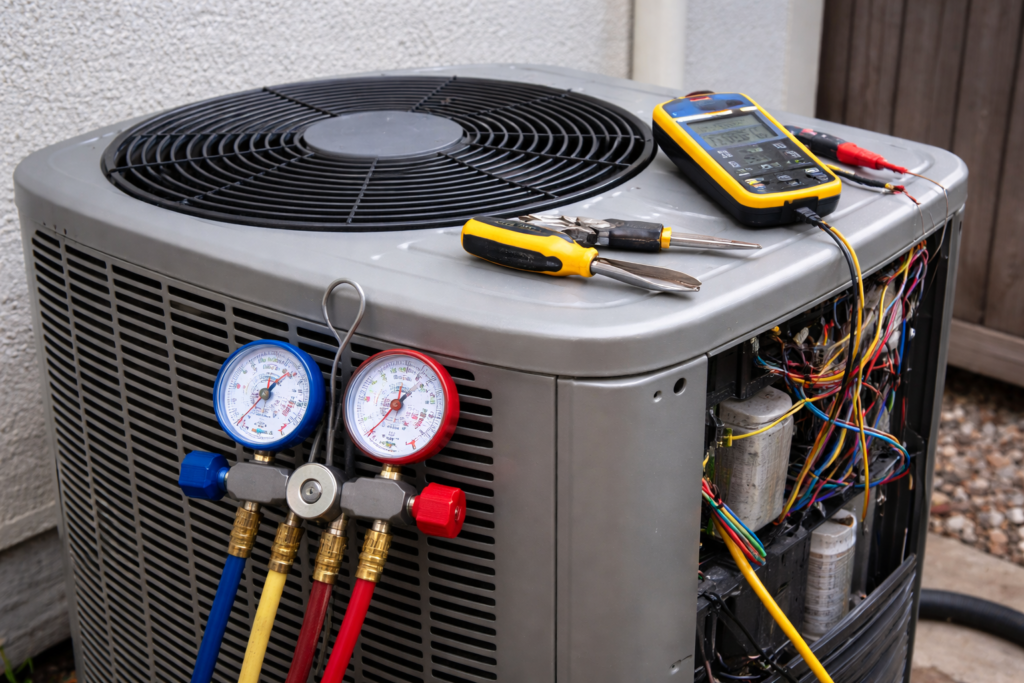
Outdoor condensers in Long Beach face salt-laden air year-round, which accelerates coil pitting and puts compressors under added strain well before the 12 to 15-year national average lifespan. The compressor handles massive pressure and extreme temperatures. When salt air corrosion eats away at the copper lines and causes the compressor to seize up, the quote to swap it out will easily jump into the thousands.
Knowing exactly when to replace AC unit hardware comes down to monitoring this degradation. If you are calling a technician two or three times a season just to keep the house cool, those emergency service fees add up incredibly fast.
The R-22 Refrigerant Problem
Another massive factor is the exact type of chemical your system uses to chill the air. Older units run on an outdated refrigerant known as R-22 Freon. Due to strict environmental regulations, this specific chemical is no longer manufactured or imported into the United States. If an old R-22 system springs a leak, the price to recharge the copper lines is astronomically high.
The Mismatched Split System Dilemma
One of the most practically confusing situations a homeowner faces involves a split system where one half has failed while the other is still functional. For instance, your outdoor condenser might be dead, but your indoor air handler is only six years old.
While it is tempting to only replace the broken outdoor unit to save money, pairing a brand-new high-efficiency condenser with an aging indoor coil drastically reduces the efficiency of the new equipment. Furthermore, manufacturers often void the warranty on new components if they are not installed as a matched set. In cases evaluating central air repair vs replacement, replacing both halves simultaneously often makes more financial sense than paying for two separate, mismatched installations a few years apart.
Breaking Down the new AC installation cost and Value
Once it becomes clear that repair is no longer the right answer, the focus shifts to making sure the replacement decision works in your financial favor for years to come.
While the upfront price of fresh equipment is significant, modern cooling technology is incredibly efficient. Based on Southern California Edison efficiency data, upgrading from a 10 SEER to a modern SEER2-rated system typically reduces cooling-related electricity costs by 20 to 30 percent—though actual savings depend heavily on your home’s insulation quality and how often you run the system.
Utilizing Local Rebates
Do not assume you have to pay the full sticker price. Southern California Edison and SoCalGas both operate specific rebate programs applicable to Long Beach homeowners that can drastically offset your initial investment. For example, Southern California Edison’s residential AC rebate program frequently offers up to $400 or more for qualifying high-efficiency systems. Check sce.com/rebates for current eligibility and exact tier values before your installation date to convert a vague financial incentive into an actionable discount.
Protecting Yourself: Questions to Ask Before You Buy
You are now prepared to understand the decision in theory, but you also need to be equipped for the actual service conversation. Before accepting either a repair or replacement recommendation, protect your financial interests by asking the technician these specific questions:
- “Can I get a written diagnostic report of the exact failure?” Never accept a verbal “it’s dead” diagnosis. A written report allows you to get an accurate second opinion if needed.
- “Will you perform a Manual J load calculation?” If they are recommending replacement, they must calculate your home’s exact cooling needs. Replacing a unit based solely on the size of the old one often leads to installing oversized, inefficient equipment.
- “Are these new components a matched set, and what are the exact warranty terms?” Ensure you are getting fully compatible indoor and outdoor units to protect your manufacturer warranty.
- “Does this quote include all necessary permit fees and ductwork modifications?” Beware of surprisingly low quotes that leave essential compliance and labor costs off the initial estimate.
The Benefits of Professional AC installation Long Beach
Living near the ocean means your equipment faces unique environmental challenges. You want a system that runs quietly, chills the air rapidly, and utilizes modern anti-corrosion treatments.
Upgrading gives you access to modern features like variable-speed blower motors and smart thermostat integration. These technological leaps ensure precise temperature control in every single room of your house, eliminating those frustrating hot and cold spots. Trusting a local, licensed professional for your AC installation Long Beach ensures the equipment is sized correctly and installed to handle the specific humidity and salt air of our coastal environment.
Conclusion
Keeping your home comfortable during a Southern California heatwave requires making informed, long-term decisions. By moving past generic rules of thumb and demanding written diagnostics, load calculations, and matched-system warranties, you take control of the process.
If your unit is relatively new and the fix involves a minor electrical component, a quick service call is absolutely the right path. However, if your coastal system is severely corroded, runs on obsolete refrigerant, or requires pairing new parts with failing hardware, investing in a properly sized, high-efficiency upgrade offers far more reliability. Approach your next service call equipped with the right questions, verify your local rebates, and make a decision that protects both your daily comfort and your long-term financial health.